
Sunroom Insulation for Texas Climate: A 2026 Homeowner’s Guide
- Haylee McCloud
- 5 days ago
- 12 min read

Why did you invest in a beautiful sunroom if you can only enjoy it for eight months of the year? For many homeowners, the dream of a light filled sanctuary turns into a 100 degree oven once June arrives. You likely already know the frustration of watching your AC unit work overtime while your monthly electricity bill climbs toward the state average of $1,801. Finding the right sunroom insulation for Texas climate demands is the only way to stop this cycle and reclaim your space. It's a common struggle, but your home doesn't have to be a victim of the heat.
In this guide, you'll learn how to transform your sunroom into a year round sanctuary that stays a crisp 72 degrees. We've used our 35 years of experience to simplify the 2021 International Residential Code requirements, such as the R-49 ceiling standards for Houston and Austin. You'll discover which local utility rebates are still active now that federal tax credits expired in 2025 and how to choose materials that stop energy leaks for good. We're going to show you how to protect your budget while finally enjoying the view you paid for.
Key Takeaways
Understand how a properly designed thermal envelope stops the "oven effect" by repelling external temperatures that often exceed 100 degrees.
Learn why moisture resistance is vital for sunrooms in humid Central Texas to prevent long-term damage and maintain air quality.
Navigate the 2026 building codes to ensure your sunroom insulation for Texas climate meets the specific R-value requirements for your local climate zone.
Discover why choosing a solid roof over a glass roof can drastically reduce your cooling costs while still providing a beautiful, light-filled sanctuary.
Find out how our "Sunroom for every budget" philosophy balances high-performance insulation with affordable project costs.
Table of Contents
The Science of Sunroom Insulation in the Texas Heat
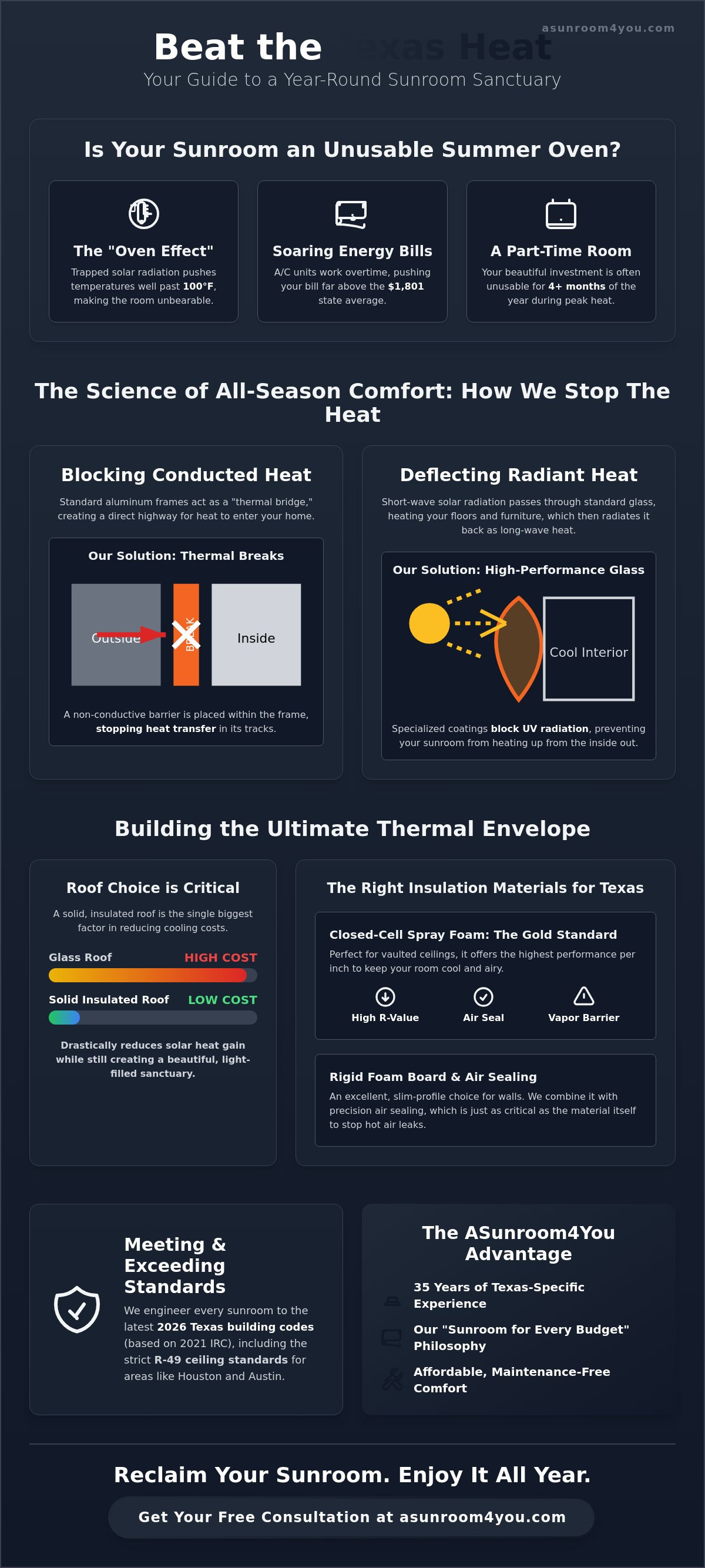
Effective sunroom insulation for Texas climate needs is about more than just stuffing foam into a wall. It's about creating a high-performance thermal envelope designed to repel external temperatures that frequently soar past 100 degrees. In our 35 years of experience building across the Lone Star State, we've seen how standard enclosures fail because they don't account for the "Oven Effect." This occurs when short-wave solar radiation enters through glass and thin roofing, strikes your interior surfaces, and converts into long-wave heat. This heat becomes trapped, quickly raising the room's temperature far above the outdoor ambient air.
Texas moisture adds another layer of difficulty. High humidity levels in regions like Central Texas make poor insulation feel "sticky" and oppressive. If your room isn't properly sealed, humid air infiltrates the space, forcing your air conditioner to work twice as hard to dehumidify. Since air conditioning already accounts for 18% of a typical Texas home's energy use, a poorly insulated sunroom can cause your monthly consumption to spike well above the state average of 1,100 kWh. The 2026 energy standards, based on the 2021 International Residential Code, now require a much more robust approach to ensure these spaces remain efficient and comfortable.
Conduction vs. Radiation: The Texas Battle
Heat enters your sunroom in two primary ways: conduction and radiation. Most sunrooms use aluminum frames for their incredible durability and low maintenance. However, aluminum is a natural conductor that creates "thermal bridging," essentially acting as a highway for heat to move from the scorching outside air directly into your home. To combat this, we use frames with a built-in thermal break. A thermal break is a non-conductive barrier placed within the support structure that snaps the connection between the inner and outer frames. While the frame handles conduction, high-performance glass must block UV radiation to prevent your furniture and flooring from absorbing heat and radiating it back into the room.
Why Traditional Home Insulation Often Fails in Sunrooms
You can't treat a sunroom like a standard bedroom addition. Traditional homes rely on thick, 4-to-6-inch wall cavities filled with bulky materials to achieve a high R-value. Sunrooms have much thinner profiles and a significantly higher glass-to-wall ratio, especially in scenic areas of San Antonio and Austin. This means every square inch of the solid structure must work harder. We've found that air sealing is just as critical as the insulation material itself. Even the best foam won't help if hot Texas air leaks through small gaps in the framing or around window tracks. A truly comfortable room requires a precision-engineered fit that stops the breeze before it starts.
Choosing the Best Insulation Materials for Texas Sunrooms
Selecting the right materials for sunroom insulation for Texas climate demands is a high-stakes decision. In a state where 100 degree days are common, your choice determines if your room is a cool sanctuary or a costly storage shed. We've seen materials degrade after just a few years of intense UV exposure, so selecting for 30 year longevity is essential. The thickness of your insulation also dictates your interior aesthetics. Thicker materials might steal your vaulted ceiling height, while high efficiency options keep the room feeling open and airy.
Moisture resistance is just as important as heat resistance in humid regions like Central Texas. When hot, humid air meets a cool, air conditioned surface, condensation occurs. Without the right materials, this leads to mold and structural rot. We prioritize sustainable materials that won't settle or off gas over decades of intense heat cycles. This ensures your investment stays as comfortable in year 30 as it was on day one.
Closed-Cell Spray Foam: The Gold Standard?
Closed cell spray foam is often the top choice for San Antonio sunrooms with vaulted ceilings. It provides a high R-value per inch, meaning you don't need a massive roof cavity to stay cool. It also acts as a built in air seal. This is vital because humid Texas summers lead to mold growth if moisture laden air reaches cold interior surfaces. Closed cell foam creates its own vapor barrier, keeping your air crisp and dry. According to 2026 industry data, closed cell foam typically costs between $1.00 and $3.00 per square foot, providing a premium defense against the heat.
Rigid Foam Board and Fiberglass Batts
Rigid foam board is an excellent alternative for homeowners wanting slim profile walls. It doesn't sag over time and offers consistent thermal resistance for sunroom insulation for Texas climate requirements. On the other hand, fiberglass batts remain a popular choice for budget friendly projects. However, they require expert installation. If batts are compressed or leave small gaps, you'll end up with "hot spots" where the Texas sun bleeds through. Many homeowners find that a hybrid approach works best to meet Texas energy codes while keeping the project affordable.
Balancing these materials requires an understanding of your home's specific orientation and sun exposure. If you're unsure which material fits your vision, you can explore our custom design options to see how we balance performance with your budget.
Texas Building Codes and R-Value Requirements for 2026
Building a sunroom in Texas isn't just a design project; it's a legal one. As of May 2026, all residential construction in the state must adhere to the 2021 International Residential Code (IRC). This code dictates exactly how much sunroom insulation for Texas climate conditions is required to ensure safety and energy efficiency. The rules change depending on where you live along the I-35 corridor. If you're in Climate Zone 3, which includes Austin and San Antonio, your requirements differ from neighbors in the North Texas Climate Zone 4 near Dallas. Following these standards ensures your room passes inspection and remains a valuable asset to your property.
One of the most important factors in your build is the "Thermal Isolation" exception. This is a specific rule in the Texas code that can save you a significant amount of money. If you maintain a legally compliant door or window between your main house and the sunroom, the room is considered "thermally isolated." In this scenario, the code only requires a minimum of R-19 for the ceiling and R-13 for the walls. However, if you remove that door to create an open floor plan, the sunroom becomes "conditioned space." This triggers much stricter requirements, often jumping to an R-49 or even R-60 ceiling R-value to match the rest of your home's thermal envelope.
Minimum R-Values for San Antonio and Austin
In Bexar and Travis counties, local building departments have become increasingly strict about energy performance. For a standard isolated sunroom, you'll need to hit that R-19 ceiling and R-13 wall mark. If you decide to install a dedicated mini-split or tie the room into your central HVAC, you must meet the full residential energy standards. This means your ceiling insulation could need to be three times thicker to comply with Austin's local amendments. Many homeowners choose to add Radiant Barriers to their roofing systems during this phase. These barriers help reflect solar heat before it even reaches your insulation, making it much easier for your R-value materials to do their job during a 105 degree August afternoon.
Permits and HOA Compliance
You can't skip the paperwork if you want to protect your home's resale value. Your initial permit filing must include specific insulation details, including the type of material and its rated R-value. Homeowners Associations (HOAs) often have their own set of rules regarding how thick your walls can look or what materials are visible from the street. We understand that navigating these layers of bureaucracy is stressful. With our "35 Years of Trust," we manage the entire permit and HOA approval process for you. We ensure your design meets both the aesthetic standards of your neighborhood and the rigorous 2026 state safety inspections. This professional oversight is why we've successfully built over 7,500 rooms across Texas.
Beyond the Walls: Windows, Roofs, and Radiant Barriers
While wall insulation is important, it only tells part of the story. In a typical Texas home, your glass choice actually determines 70% of your interior comfort level because glass is the primary entry point for solar radiation. Even the best sunroom insulation for Texas climate won't help if your windows act like a magnifying glass. We also have to consider your home's orientation and the 300 days of sunshine we get annually. A West facing sunroom absorbs the full brunt of the afternoon sun, often requiring twice the insulation effort compared to a North facing room to maintain a steady 72 degrees without your AC running 24/7.
Radiant barriers are the secret weapon for Texas homeowners. This technology, originally developed for space suits, uses a highly reflective surface to bounce up to 97% of radiant heat away from your roof before it ever touches your bulk insulation. Most competitors overlook this step, but we've found it's the most effective way to lower energy consumption during our brutal July and August heatwaves. By reflecting heat rather than just slowing it down, you create a much more efficient thermal envelope that protects your cooling costs.
Low-E Glass and Argon Gas Fills
When choosing glass, look for the Solar Heat Gain Coefficient (SHGC). In plain English, this number tells you how much solar heat the window lets in. For our climate, you want a low SHGC, typically below 0.25. Standard double pane glass isn't enough; you need spectrally selective coatings that block heat without losing your view. Argon gas acts as a dense thermal buffer between the panes to significantly slow down heat transfer. This combination keeps the glass surface cool to the touch even when it's 105 degrees outside.
Solid Roof Systems and Ventilation
For maximum comfort, solid roof sunrooms are almost always better for Texas than glass roofs. While a glass roof looks beautiful, it creates a greenhouse effect that is nearly impossible to cool in San Antonio or Austin during the summer. Our high performance insulated panels provide much better thermal resistance than standard shingles, which can reach 150 degrees on a hot afternoon. We also recommend pairing your insulation with a high quality ceiling fan. A fan doesn't lower the temperature, but it helps the air conditioning feel 4 degrees cooler by moving air across your skin. If you're debating between styles, request a free survey today to see which roof system fits your home's orientation best.
The ASunroom4You Approach: Affordable, Maintenance-Free Comfort
Choosing the right partner for your home improvement project is just as important as the materials you select. At ASunroom4You, our 35+ years of experience building across the state has taught us that sunroom insulation for Texas climate needs isn't a one-size-fits-all solution. We've refined our strategies over decades to ensure your new space isn't just beautiful, but also incredibly efficient. We operate on a "Sunroom for every budget" philosophy. This means we work closely with you to balance high-performance R-values with your specific project costs, ensuring you get the most value for every dollar invested. Our signature promise is simple: Best Products, Best Price, Best Value... Guaranteed!
We understand that a sunroom is an investment in your quality of life. That's why we focus on maintenance-free materials that stand up to the punishing Texas sun without fading, warping, or losing their thermal properties. Whether we're building a solid roof sunroom or a patio enclosure, our goal is to create a seamless extension of your home. We've built Over 7,500 Rooms in Texas, and each one represents our commitment to being a trustworthy, neighborly craftsman for our community.
Custom Design for Local Climates
Texas is a massive state with diverse weather patterns. We tailor our insulation strategies to meet the specific demands of your city. For our customers in San Antonio, we focus heavily on moisture-resistant barriers to combat the region's higher humidity levels. In Austin, where the summer heat can be particularly intense, we prioritize advanced reflective technologies and spectrally selective glass. This custom approach ensures a "seamless integration" with your existing home's thermal envelope. By matching the insulation performance of your sunroom to the rest of your house, we prevent the temperature swings that often plague lower-quality additions.
Start Your Journey to a Cooler Home
The path to a comfortable, year-round sanctuary begins with a professional assessment. Every home has unique thermal needs based on its orientation, existing shading, and the condition of the current foundation. Our process starts with a comprehensive check of your existing patio slab to ensure it can support the new structure while maintaining a proper thermal break from the ground. We take the guesswork out of the equation, handling all the technical details so you can focus on how you'll use your new space. We're ready to turn your outdoor dream into a reality that keeps you cool even in the middle of August. Schedule your FREE in-home survey today! and let's make your home feel Right… At Home!
Start Enjoying Your Texas View Year-Round
Your sunroom should be a place for relaxation; not a source of stress or high energy bills. By understanding the 2026 building codes and choosing high-performance materials like closed-cell spray foam and Low-E glass, you can create a sanctuary that defies the 100-degree heat. Investing in the right sunroom insulation for Texas climate challenges is the difference between a room you use daily and one that sits empty during the summer months.
We bring Over 35 Years of Trust in Texas to every project we touch. With 7,500+ Sunrooms Built across the state, our fully licensed and insured professionals know exactly how to handle the unique thermal needs of your home. We're here to help you navigate the R-value requirements for San Antonio and Austin so you can focus on enjoying your beautiful new space. Don't let another brutal summer keep you indoors.
Get Your FREE In-Home Sunroom Survey & Quote Today!
It's time to turn your outdoor dream into a comfortable reality. We're ready to help you feel Right… At Home!
Frequently Asked Questions
Is it worth insulating a sunroom in Texas if I only use it in the mornings?
Yes, insulating your space is definitely worth the investment. Texas temperatures often hit 85 degrees before 10:00 AM, and without protection, solar radiation starts building up early. Proper insulation prevents the "oven effect" from taking hold. This ensures your morning coffee remains comfortable and protects your indoor plants from wilting as the sun rises higher in the sky.
What is the best R-value for a sunroom roof in San Antonio?
For a thermally isolated sunroom, the 2021 International Residential Code requires a minimum of R-19. However, many San Antonio homeowners choose to upgrade to R-49. This higher value matches the standards for Climate Zone 2. It's the best way to ensure your AC doesn't struggle when the afternoon sun is beating directly down on your roof panels.
Can I add insulation to an existing screen room or patio enclosure?
We can often convert your existing screen room into a fully insulated patio enclosure. This process involves replacing screen mesh with insulated wall panels and high-performance glass. During our free survey, we'll check your existing slab and framing. We need to ensure the foundation can support the weight of modern sunroom insulation for Texas climate standards before we begin the upgrade.
Will insulating my sunroom significantly lower my whole-home energy bill?
Insulation creates a barrier that prevents heat from soaking through the shared wall into your main living area. Since Texas households consume about 1,100 kWh per month, every bit of efficiency helps. By stopping the sunroom from acting as a giant heat sink, your primary air conditioner doesn't have to run as long to keep the rest of your home at 72 degrees.
What is the difference between a 3-season and 4-season sunroom regarding insulation?
A 4-season sunroom features a complete thermal envelope, including insulated frames, double-pane Low-E glass, and high-performance roof panels. It's designed to be used even when it's 105 degrees in Austin. A 3-season room lacks this robust sunroom insulation for Texas climate needs. It's better suited for the mild weeks of spring and fall rather than the brutal peak of a Texas summer.
Does the Texas building code require a specific type of glass for sunrooms?
The 2021 IRC requires safety glazing for all glass in sunroom walls and doors. Beyond safety, the code also sets limits on the Solar Heat Gain Coefficient (SHGC). In most of Texas, your glass must have an SHGC of 0.25 or lower. This specific rating ensures that the glass reflects the majority of solar heat rather than letting it into your room.
How much does sunroom insulation typically add to the total project cost?
The cost depends on your choice of materials. According to 2026 data, closed-cell spray foam typically costs between $1.00 and $3.00 per square foot. While this adds to the initial budget, it's a practical investment. High-quality insulation lowers your monthly cooling costs and prevents expensive moisture damage or mold growth in our humid Gulf Coast and Central Texas regions.
Can I use a portable AC unit if my sunroom isn't fully insulated to code?
You can use one, but it won't be very effective. Without proper insulation, heat enters the room faster than a portable unit can remove it. You'll likely find the room feels "sticky" because these units can't handle the high humidity levels found in San Antonio. It's much more efficient to insulate the space correctly so your cooling system actually works.


Comments